Workflows
Use workflows to extend Alfred and get things done in your own way. By replacing manual tasks or mouse-based actions with workflows, you'll boost your productivity.

Overview: What are workflows?
NoteWorkflows are part of the Powerpack features available in Alfred.
You'll find the Workflows section in Alfred's preferences under the "Workflows" header. Take a look at the topics below to discover how workflows can help you make repetitive tasks a thing of the past, making you more efficient on your Mac in ways you never thought possible!
Want to jump in right away? Install a few "great for learning" workflows from the Alfred Gallery to see your first workflows in action! :)
Introducing Workflows
- Getting Started Guides to Workflows
- Installing new workflows
- Creating your own workflows
- Workflow object types
Discovering Workflows with the Getting Started Guides
When you first navigate to the Workflows section of Alfred preferences, there are no active workflows in the left sidebar.
You can browse our recommended workflows in the Alfred Gallery. As the official source for Alfred workflows, the Gallery provides an easy way to discover workflows created by our amazing community, as well as safely install and update them.
Keen to create your own workflows? The best way to learn how to create Workflows is with the Getting Started Guides, which you'll see in the centre of the Workflow Editor canvas when no workflow is selected.

You can follow along with written companion guides to the Getting Started Guides to Workflows.
Installing new Workflows
To install an Alfred Workflow, double-click the .alfredworkflow file to import it. On import, you'll see a page where you can configure the workflow, see the hotkeys available and read a short introduction to the workflow - if the creator has included this.
Use the "Import" button or Cmd + Return to complete the import.
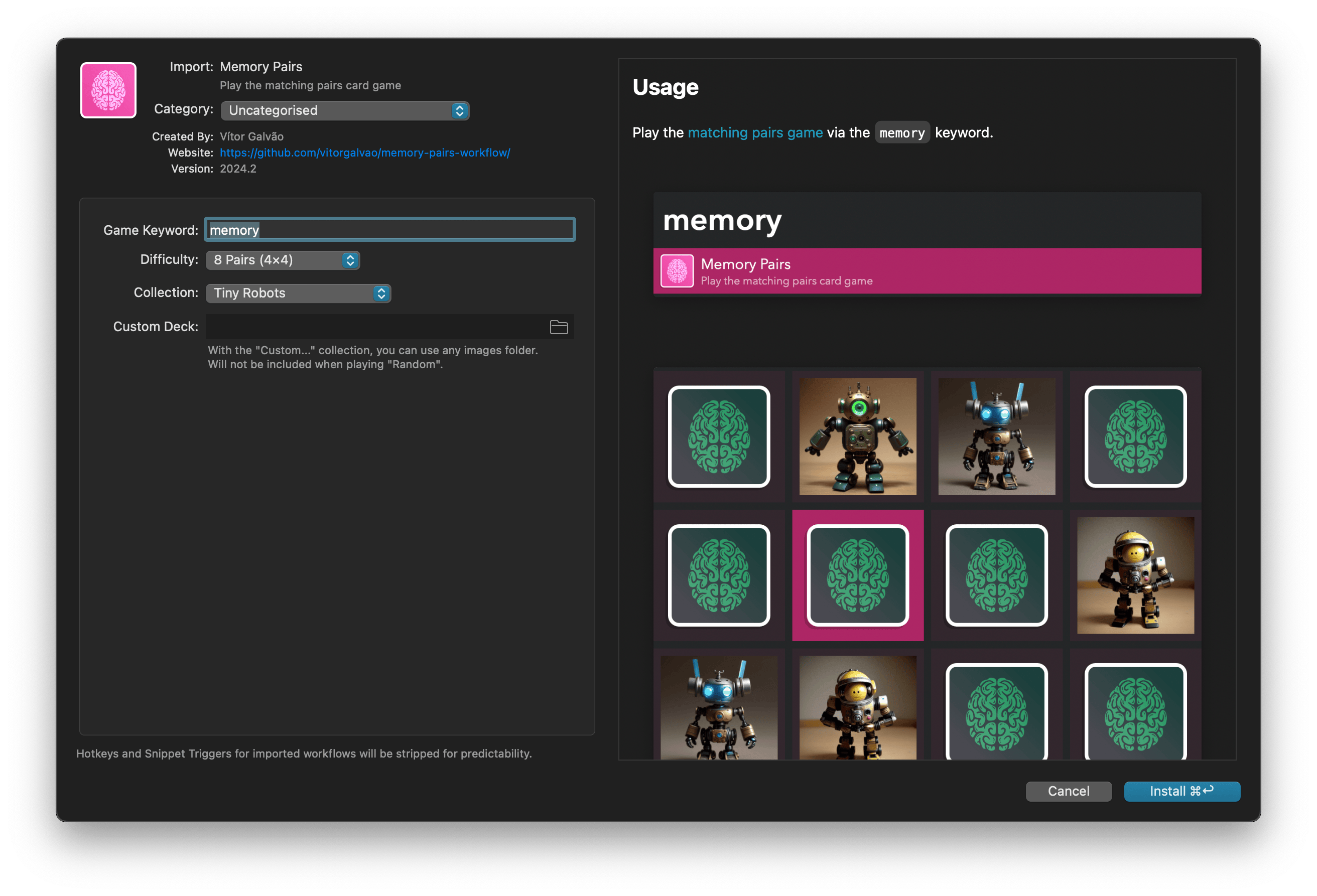
You'll find excellent workflows on:
- The Alfred Gallery.
- The Alfred Forum, where you can also find help with your own workflows.
- The creators' own websites, and on Github.
NoteSome of the workflows you find may have been created using older versions of Alfred. These should import and work perfectly in the current version of Alfred as well.
Please note that workflows are not always backwards compatible to earlier versions of Alfred.
Creating Your Own Workflows
In Alfred's Workflow Editor, you'll see a few options in the centre of the screen when no workflow is selected. You can create a new blank workflow or start with a template.
Add new objects to with the Workflow Palette on the right. Click objects to select them, and reposition by dragging. With an object selected, ⌥ + click on another to connect them. Double click (or right-click > Configure Object...) to edit its settings.
The workflows tagged with "Learning" on Alfred Gallery offer good examples for workflow creation.
At any time, you can find help on a specific object by clicking the question mark icon in its settings in Alfred's Preferences. And most of all, have fun!
NoteNew in Alfred 6: Alfred UI Objects
Alfred UI brings a fully macOS native UI toolkit to Alfred, allowing you to create beautiful, interactive UIs for your workflows.
Discover Alfred UI's rich documentation, or start by taking a look at our Alfred UI-based workflows.
Workflow object types
TipEvery Workflow object includes a question mark icon in its configuration panel when you double-click the object. Click it to be taken to the relevant page and find out more about that particular object.
- Triggers: Activate Alfred from a hotkey, another Alfred feature or an external source.
- Inputs: Objects used to interact with the workflow from Alfred's default results, with keywords and connected inputs.
- Actions: The objects that do most of the work in your workflows; opening or revealing files and web searches, running scripts and performing commands.
- Automations: These building blocks let you automate tasks without having to write any code.
- User Interface: Present results in Alfred in convenient ways, such as a grid of images and files, an editable and interactive text view and more.
- Utilities: Utilities give you control over how your objects are connected together and how the arguments output by the previous object is passed on to the next object.
- Outputs: Collect the information from the earlier objects in your workflow to pop up a Notification Centre message, show output in Large Type, copy to clipboard or run a script containing the result of your workflow.
Making the Most of Workflows
Once you've grasped the basics of workflows, you'll find numerous ways to improve them; From simply organising and sharing them with fellow Alfred users, to using variables and scripts to create an advanced workflow.
- Automation Tasks: 3 Workflows to discover the power of Automation Tasks
- Organising workflows with categories and defaults
- Exporting and Sharing Workflows
- Workflow Troubleshooting
- Using the Workflow Debug Utility
Advanced workflow topics
- Using AlfredUI to create beautiful workflows
- Setting Variables in Workflows
- Prepopulated Environment Variables
- Using Alternative Actions in workflows
- Using Script Filter objects
- Workflow Object Inbound Configuration
Need help with workflows? Pop by the Alfred forum to chat with fellow creators and find answers to your questions. :)